
What to Expect in an Antenna Engineering Exam at TU Chemnitz
12 August 2026
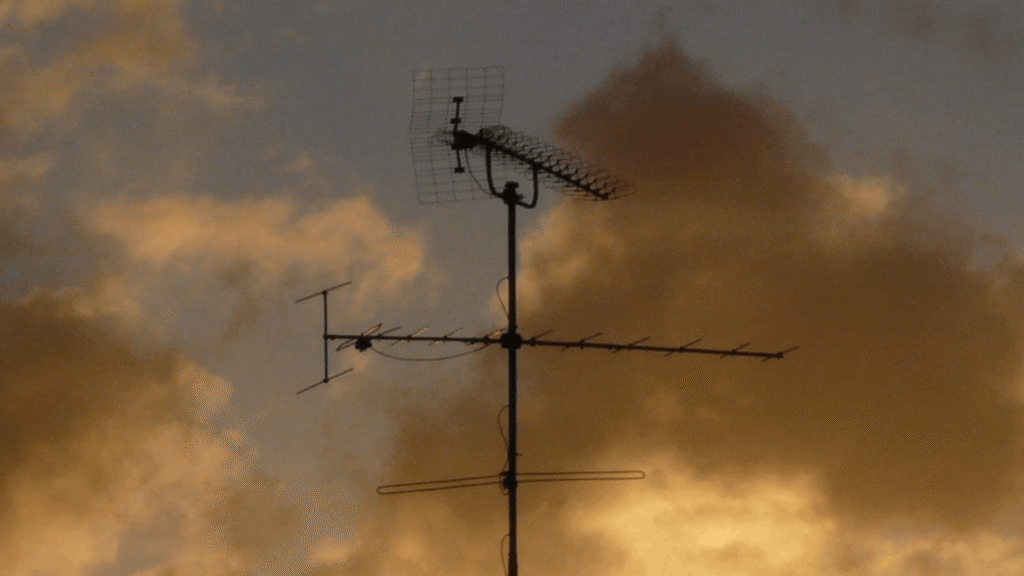
If you have an upcoming antenna engineering course, you might be wondering what kind of questions show up on the written exam, especially when it covers both theoretical concepts and practical simulation work.
I recently took my written exam where we were tested on core antenna fundamentals, simulation setup details, and measurement procedures. To help anyone preparing for similar exams, here is a breakdown of the main questions that came up, along with clean and straightforward answers for each.
What are the two common definitions of an antenna?
- An antenna: That part of a transmitting or receiving system that is designed to radiate or to receive electromagnetic waves.
IEEE Std 145-1993, IEEE Standard Definitions of Terms for Antennas - An antenna is a metallic object which transform conducted electromagnetic waves from a wave guide to free space electromagnetic waves.
What parameters can you measure or derive from S11?
- Resonant Frequency (Hz)
- Frequency Bandwidth (Hz)
- Impedance (ohm)
- VSWR (unitless)
Name 3 types of omnidirectional antennas
- Dipole Antenna
- Monopole Antenna
- Discone Antenna
plot and evaluate the S11 curve of your design
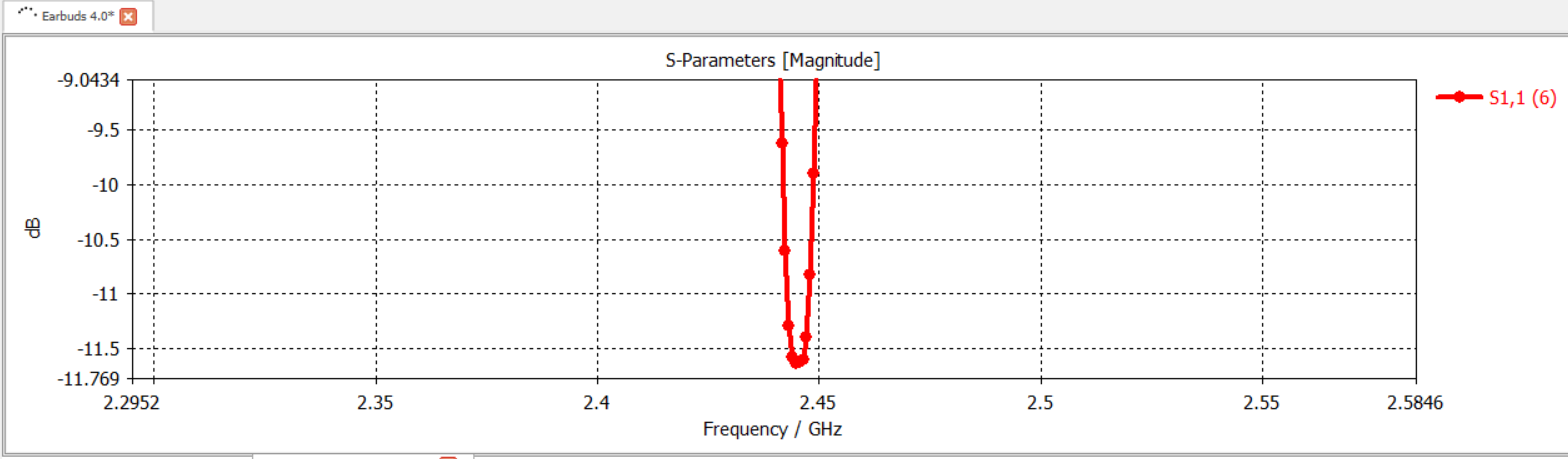
S11 curve shows a sharp resonance centered at 2.445 GHz. This confirms that the design successfully meets the standard -10 dB matching criteria in the 2.4 GHz Bluetooth band, ensuring efficient power transfer with less reflected energy.
Why is S11 expressed as a negative number?
S11 represents the ratio of reflected power to input power. Since an antenna cannot reflect more power than it receives, the magnitude of the reflection coefficient Gamma |Γ| is always between 0 and 1. When you convert a fraction between 0 and 1 into decibels using 20 log10 |Γ|, the mathematical result is always negative.
What is considered a good S11 value, and did your design reach it?
An S11 value of -10 dB or lower is generally considered the benchmark for a good antenna. Values like -15 dB or -20 dB represent even better matching.
What is the difference between a Waveguide Port and a Discrete Port in CST Studio?
- Waveguide Port: Placed on the simulation boundary. It calculates the exact electromagnetic field modes and wave impedance of your feed. Use it for maximum accuracy on coaxial cables, microstrip lines, and waveguides.
- Discrete Port: Placed inside the simulation structure. It connects two points like a simple voltage/current source with a fixed internal resistance (e.g., 50 Ω). Use it for fast setup across small gaps, wires, or lumped elements.
Name 5 parameters in CST Studio software that affect your simulation results
Mesh Density: Finer meshes increase accuracy near small details but require longer computation time.
Boundary Conditions: Setting boundaries to “Open (Add Space)” prevents artificial wave reflections from the edge of the calculation domain.
Solver Accuracy Threshold: The energy decay limit (such as -40 dB) required before ending a time-domain simulation.
Substrate & Material Properties: Relative permittivity and loss tangent directly shift the resonant frequency and radiation efficiency.
Port Dimensions: Port sizes that are too small cause field clipping and incorrect port impedance calculation.
What steps should you follow before running a simulation in CST?
- Takes antenna application requirements / antenna specification
- Sketches on paper the antenna design based on experience
- Scales the antenna design
- Converts the antenna design into a 3D CAD design
Draw the experimental test setup used to determine the radiation gain of an Antenna
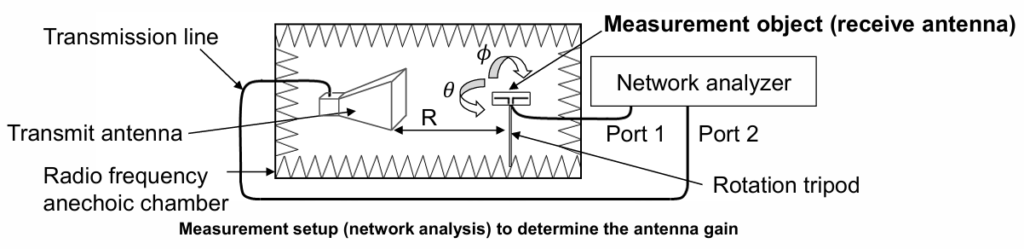
To be completely honest, I spent days preparing for heavy mathematical derivations and complex formulas before this exam, but in the end, not a single math question came up! The exam was very practical and focused on actual antenna engineering logic, making it straightforward to score full marks if you knew your simulation and measurement fundamentals. I hope this breakdown gives you a clear idea of what to expect and helps you in your own exam prep.
Thank you for reading, and I hope you found this useful!